Seventeen Seconds
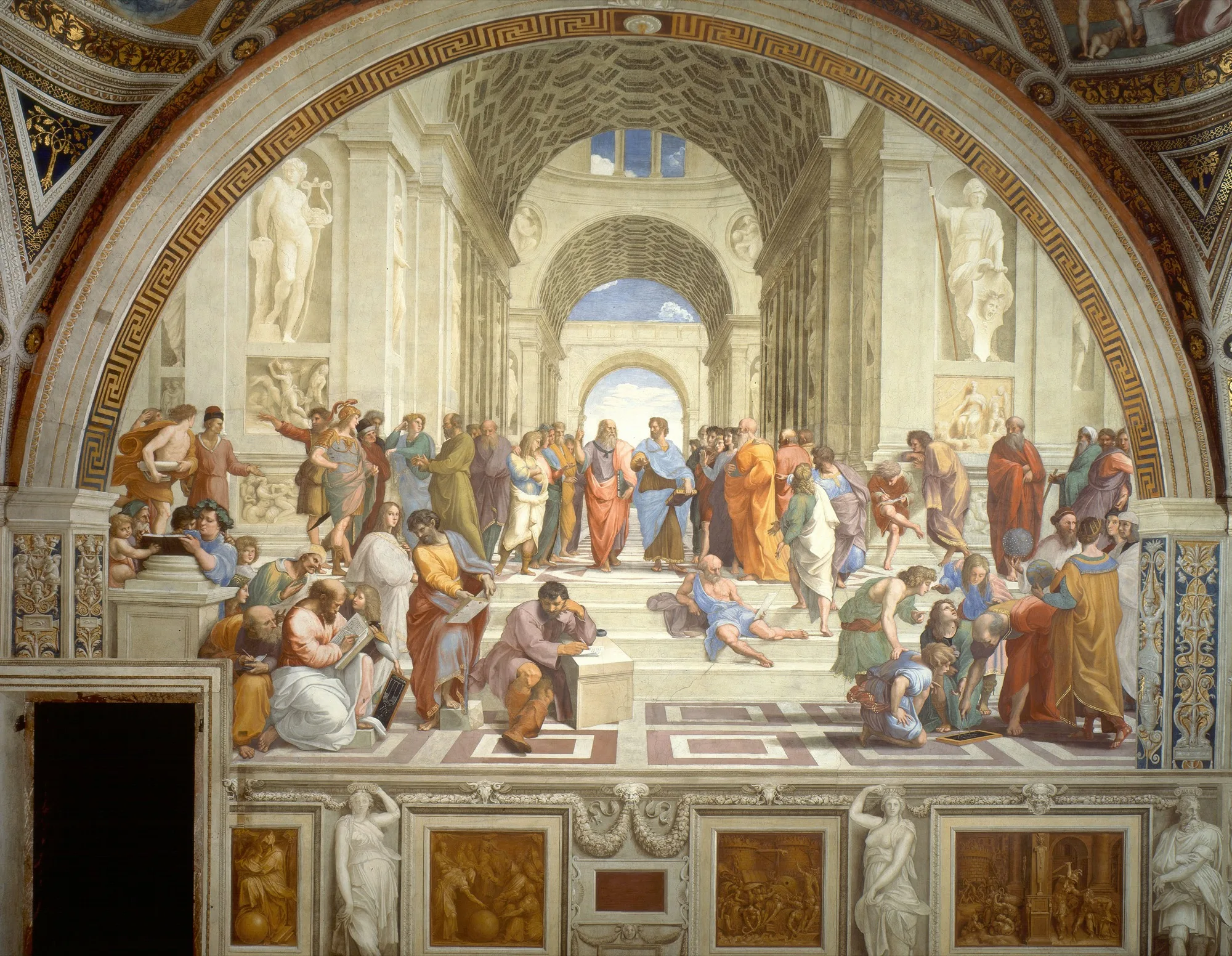
Raphael, The School of Athens, about 1509–11. Vatican Museums
You can walk through a museum and see a bunch of nothing. Or you can stop for a moment, pause, and look.
Most of us walk. In 2001, two researchers at the Metropolitan Museum of Art, Jeffrey and Lisa Smith, quietly timed 150 visitors in front of six of the museum’s great paintings. The median was 17 seconds. When they ran the study again at the Art Institute of Chicago, the most common time was 10, and enough people were taking selfies with the paintings that the researchers gave them a name: “arties.”
It’s easy to blame the attention economy for that. But “attention economy” is a phrase that’s floated around my head for a while, and if I’m being honest, I couldn’t tell you what it means.
So I tried to work it out. Economics, as I understood it, is the study of money: where it goes, how we grow it, what we trade it for. An attention economy, then, would be the study of where our attention goes.
Seventeen seconds is part of the answer. But time isn’t the whole story. Put two people in front of Raphael’s School of Athens for the same seventeen seconds. One sees a crowd of men in robes, glances, and keeps moving. The other knows it’s a gathering of the great thinkers of the ancient world.
Plato stands at the center, pointing up, holding his Timaeus. Beside him, Aristotle carries his Ethics. Even their gestures carry the argument between them: Plato’s finger toward the heavens, Aristotle’s hand held out flat over the ground, usually read as the ideal world against this one. The brooding man on the steps, Heraclitus, is a portrait of Michelangelo, who was painting the Sistine Chapel nearby at the time, and Raphael put himself at the far right. And all of these pagan philosophers are on a wall in the Vatican, in rooms Raphael painted for Pope Julius II. Know that, and seventeen seconds isn’t nearly enough.
Same painting, same seconds. The difference is what each of them brought.
What you bring
Taste isn’t something you’re born with. It’s collecting dots: every food, place, song and conversation you’ve been exposed to, stored up so you can reference it later.
I like curry, so maybe I’ll like Thai curry. Thai curry was okay; let me try Indian. I liked the beach in Cancun, so what’s the beach in the Philippines like? And if that one’s in Asia, what about Phuket?
That’s how you start comparing and contrasting, and it applies to food, to music, to everything that makes a culture. Travel works the same way. Without the history, a new city can be just another town. Know the story, and you appreciate it differently. A painting is no different.
The French sociologist Pierre Bourdieu made this argument in 1979, more precisely than I can. “The capacity to see (voir) is a function of the knowledge (savoir),” he wrote. His word for what you absorb growing up was habitus, and his point was that the dots get handed out unevenly, and early. The kid who grew up with museum Sundays doesn’t try harder in front of the painting. She just has more to read it with.
What you have left
We treat money as a finite resource. We can see it in our accounts. We track where it goes, how far in the red we are, what the interest rate is. Nobody sends us a statement for attention, except, lately, our phones.
In the movie In Time, time literally is the currency. A glowing countdown clock built into your forearm shows how much time you have left, and you pay for things with it. But even there, you could separate the two. You can have all the time in the world. What does your attention go to?
We’ve all heard about the people who go on vacation and aren’t even there, on their phone the whole time, sitting on a beach somewhere.
In 1971, the scientist Herbert Simon put the mechanics plainly: “What information consumes is rather obvious: it consumes the attention of its recipients. Hence a wealth of information creates a poverty of attention.” Much of what’s free on your phone is paid for by advertising, which means it’s paid for with attention. By the time you reach the gallery, some of yours is already spent.
Time is not attention
For a long time I put time and attention in the same bucket. Watching my son changed that. The attention we give him comes back to us as who he’s becoming.
They aren’t the same. Attention is the value of your currency. You can win back a Tuesday, the day you don’t have to clock in, and still not be in it.
That’s what this publication follows: not how many Tuesdays we have, but what we do with them when we get them back.
Your turn
Next time you’re in front of something worth looking at (a painting, a person, an ordinary afternoon), ask how you’re receiving it. What did you bring to it? What do you have left?
And if the answer is seventeen seconds, where did you learn to look that way?
Source notes
- Raphael, The School of Athens (about 1509–11), Stanza della Segnatura, Vatican Museums.
- Jeffrey K. Smith and Lisa F. Smith, “Spending Time on Art,” Empirical Studies of the Arts 19, no. 2 (2001).
- Lisa F. Smith, Jeffrey K. Smith and Pablo P. L. Tinio, “Time Spent Viewing Art and Reading Labels,” Psychology of Aesthetics, Creativity, and the Arts 11, no. 1 (2017).
- Pierre Bourdieu, Distinction: A Social Critique of the Judgement of Taste (1979; trans. Richard Nice, 1984), p. 2.
- Andrew Niccol, In Time (2011).
- Herbert A. Simon, “Designing Organizations for an Information-Rich World,” in Martin Greenberger, ed., Computers, Communications, and the Public Interest (1971), pp. 40–41.